
Goshalla
The cow is the mother of the whole world.
"The cow is the source of progress and prosperity. In many ways she is superior to one's own mother." -Mahatma Gandhi
On awakening this knowledge, the desire to love and care for cows will become natural, thus contributing to inner peace and to the harmony of society.
For the Indian villager with his agrarian life, the conservation of natural resources is an integral part of daily existence. He is expert in using nature’s gifts to manufacture all his requirements, from his mud hut to his homespun clothes. And protecting cows has always been the most important feature of the village conservation program; every homestead has at least one cow.
The cow and bull are indispensable in rural India, where about eighty percent of the population lives. The cow, eating only grass, happily supplies milk, which provides virtually all of the nutrients our bodies need. From milk we get cheese, curd, butter, ghee, whey, cream, yogurt, and an endless variety of milk-based preparations well known to experts in traditional Indian cookery. Because the cow supplies milk, she is accepted in the Vedas as our mother.
The bull is also an invaluable asset to the small farmer. The strong bull enjoys working all day pulling a plow through the fields. The use of the bull may be slower than machinery, but it does not compact the soil and reduce its productivity as doe’s heavy modern machinery. There are other problems with machinery in India, such as its inability to cope with seasonal changes and monsoons. (What to speak of the problems of finding spare parts or a mechanic). Because the bull provides for food, he is considered our father.
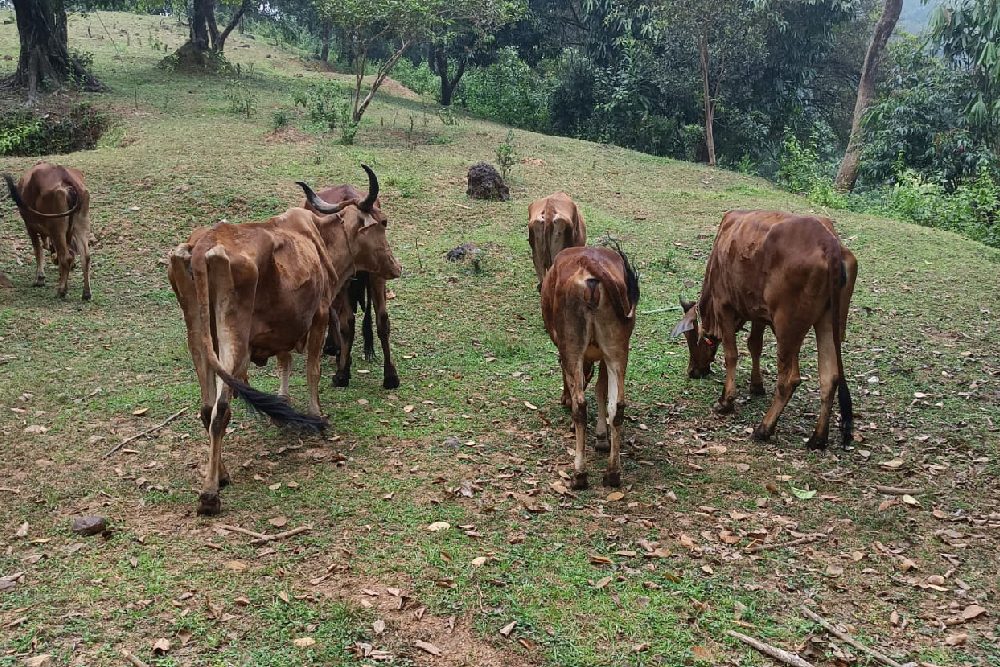
GIFTS OF MOTHER COW
Milk is much more than a healthy substance. It is the manifestation of a mother’s love. When a baby drinks the milk from its mother, what takes place is not only bodily nourishment but a deeper bond with the mother. The natural relationship with the cow, our second mother, is now almost lost as we drink milk stored in cartons, vaguely conscious of its source.
“Cows milk is a tonic, its ghee is ambrosia and its meat is disease.” – Hazarat Mohammad
Cow dung is also regarded as the most efficient of all natural fertilizers. Thus the cow helps in the process of growing organic crops to maintain humanity as well as herself. The wonderful thing about agriculture is that what ever we can not eat the cow will and in turn she returns the same back to the soil in the form of cow dung fertilizer.
Cow milk is the most nutritious food. It contains protein, fat, nitrogen, calcium, iron, copper, iodine, florin, 25 types of minerals and the vitamins A, B, C, D, and E.
Scientists have declared milk to be especially beneficial for mothers and pregnant women. It helps with a child’s growth in the womb, replenishes the body and restores the necessary nutrients lost during child birth. It also provides the necessary surplus elements that mothers use in breast feeding. Just as a mother’s breast milk is the most nutritious food for her child, cow milk is similarly an incomparable source of energy for mothers.
Ayurveda long ago declared milk to be highly curative in many diseases. Scientists have also discovered that milk can help prevent even diseases such as cancer. Milk fat is the richest natural dietary source of conjugated lanolin acid (CLA), which has been shown in animal and cell culture studies to have potent anti-carcinogenic (anti-cancer) properties. Experiments have shown that dietary supplementation with CLA reduced the incidence of chemically induced tumors in the epidermis, stomach and mammary glands.
Science has discovered that the burning of cow ghee purifies the air. When cow ghee is burned with rice it produces ethylene oxide, propylene oxide and formaladeyore. Ethylene oxide and formaladeyore, which are used in the operation theatre, provide immunity from bacteria.
Cow urine and dung have also been analyzed in laboratories and proven to contain disinfectant and antibiotic properties. Through many experiments on cow dung, the famous Italian scientist, Prof. G.E. Bea, has proven that fresh cow dung kills the germs of Malaria and Tuberculosis. Cow urine contains 24 types of salts as well as iron, calcium, phosphorous, carbonic acid, potash and lactose. For diabetics, tests have shown that it controls the sugar level and acid fitness.
These are just a few indications of how cow products are invaluable to mankind and how science is helping to confirm this forgotten truth.